

October 5, 2026
Dear PRSF supporters and friends:
On September 20, Protect Rancho Santa Fe wrote forwarded a letter that the Board should apply and enforce the Covenant we have. That letter answered Pascal Stolz’s earlier letter, “The Right Fight, The Wrong Battlefield.” We both agreed on the division of work between the Association and the County. Traffic studies, CEQA, fire-evacuation modeling, and the Major Use Permit belong at the County, and we have already taken those issues to the forums that can decide them.
Where our letter said the Board went wrong is what this reply takes up. Resolution 2025-102 is not a substitute for the Protective Covenant. Fair housing law is not a trump card that requires the Board to approve a land use the recorded documents do not allow. The directors’ fiduciary duty is not a duty to choose the lawsuit the Board thought it could survive. It is a duty to apply and enforce the governing documents that bind every Building Site equally.
Pascal Stolz recently replied with “The Door That Closed And A Path Still Open.” We have answered him, and we are forwarding that answer to you. A reply that takes the argument seriously is more useful than one that does not. His does on some of the points that matter most.
What follows is the “abbreviated” version of PRSF’s full response to Mr. Stolz’s letter. Our full response, Mr. Stoz’s letter, and the related source documents, can be found here.
Where we agree
The six-person line. Health and Safety Code § 1569.85 treats a licensed care home of six or fewer people as a house. Silvergate’s memory-care wing, 44 proposed suites, sits well past that line. The statute does not turn the wing into a residence.
The statute is not the whole of Article I, Paragraph 1. The Covenant determines whether an institution may be built and operated on Covenant land. He asked the Association to explain, on the 1928 text, why memory care falls outside that prohibition. That question is still open. Resolution 2025-102 never cites Paragraph 1, and it never makes that explanation. The Board owes every Covenant member an answer.
Fair housing is not a trump card. Those laws constrain what the Board may refuse. They do not expand what the Covenant permits. A reasonable accommodation is a case-by-case adjustment so a particular person can use a dwelling the governing documents already allow. It is not a project-wide authorization for a use the Covenant does not list. He wrote that Paragraph 3 of the resolution “goes further than it needed to,” and that the Board’s case “belongs in the Covenant, not in housing law used as a workaround.” On this we also agree.
The Board’s own work is not finished. What remains is concrete: apply Paragraph 1; apply the dual Class C and Class L classification on these Block M parcels; apply the 1,750-square-foot rule the Art Jury put on the table in October 2024; and use the modification paths in Paragraphs 164 and 165 and Chapter 80, which were not used. None of that asks the Board to do the County’s job. It asks the Board to finish its own.
The door did not close
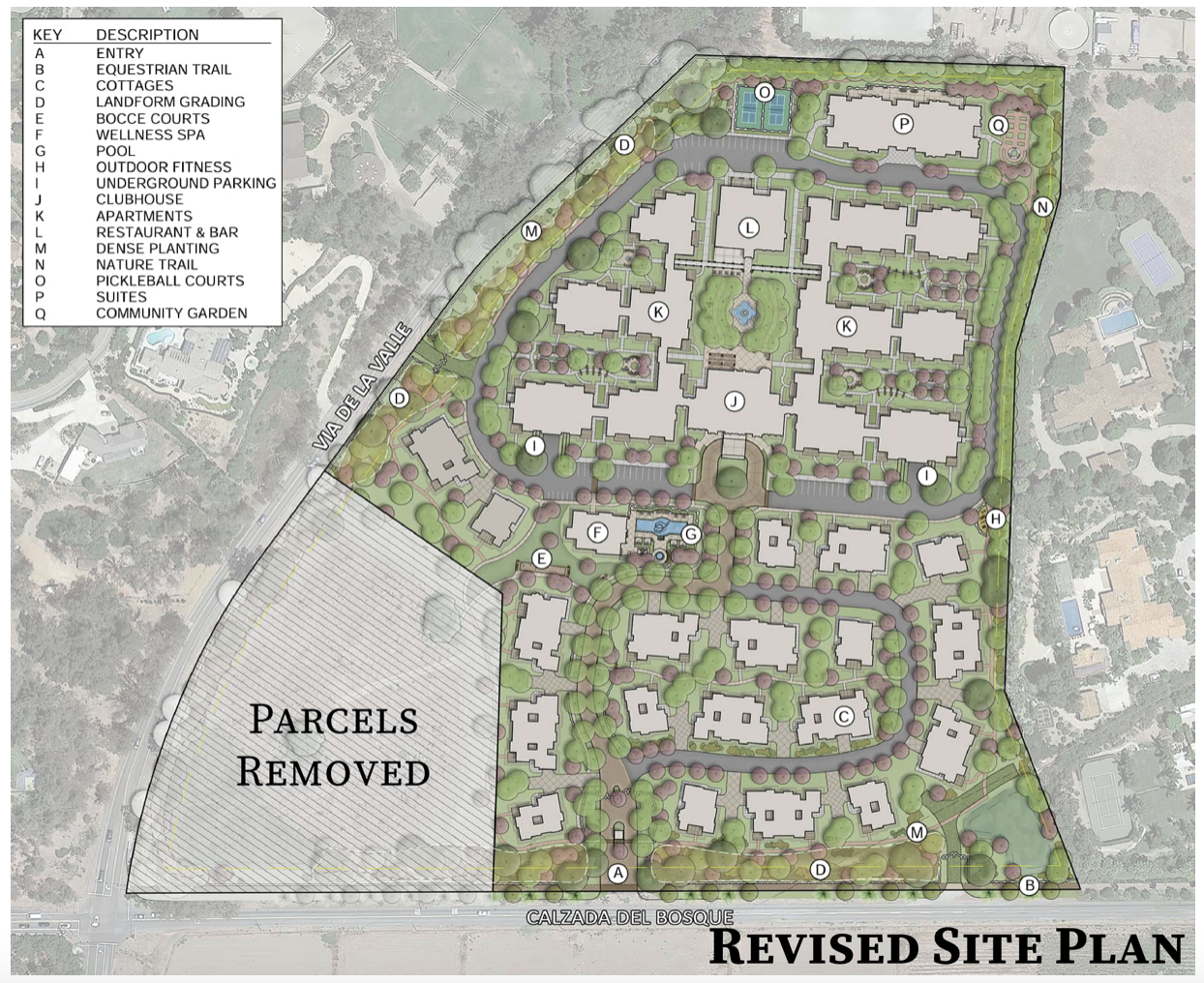
Two of the four parcels sat outside the Covenant. The Art Jury conditioned continued review on annexation, which would have given members a vote. The developer withdrew those parcels. Association review then narrowed, and the vote never happened. Withdrawing them narrowed the Art Jury file. It did not narrow the County file, and it did not leave those two parcels as a blank sheet.
On August 21, County staff told the applicant to remove the notation “County Parcel-not a part” from the plans. The project is being evaluated on the full 28 acres and all four parcels, because the bioretention basins – the stormwater control – are part of the whole project. Those basins sit on the land his drawing treats as outside the application. Drainage is why the two non-Covenant parcels are still in the County file.
The August 28 scoping letter is addressed to Silvergate RSF, LLC, at 5708 and 5844 Calzada del Bosque, and to all four parcels. Our meeting with the County on September 29th confirmed the disparity his illustration skips. The project before the County is 168 units on four parcels. The project before the Art Jury is 168 units on two. Same unit count. Half the parcels.
What the Art Jury vote was, and what 23 percent is not
The August 25 vote moved the file to phase-two landscape and lighting. It was not approval of the project. A variance is still required. Each multifamily unit needs at least 1,750 square feet. Fifty-two of the apartments are 1,440 square feet, and the memory-care suites are 375 square feet. The Art Jury said on October 8, 2024, that a variance must be sought or the units redesigned. Notice of that hearing goes to owners within 500 feet before final review.
Twenty-three percent coverage, if that is the figure, is under the Class C ceiling. It is not a grant. The ceiling does not entitle the owner to build until the ceiling is reached, and keeping a licensed campus under 50 percent coverage does not make it a use the Covenant lists. The ceiling limits how much of the lot may be covered. It does not authorize the use.
The “it will be worse” argument
When the case for the current project is pressed, the reply often offered is that something worse may follow if this one is stopped. His version is the illustration captioned “What Could Be Built Without Annexation.” The drawing does not fit the land it claims to occupy. The uses it suggests are not waiting, once the Covenant and the County ordinance are actually applied.
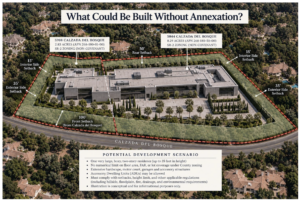
The details are wrong. The two non-Covenant parcels are 2.83 and 2.91 acres, about 5.74 acres together. The two Covenant parcels are 14.65 and 8.29 acres, about 22.94 acres together. The non-Covenant land is about 20 percent of the site. The setback is an “A”: 100 feet in front, 15 feet on an interior side, 35 feet on an exterior side, and 50 feet in the rear. On parcels of that size, the yards consume most of the pad. The illustrated campus – wings, a motor court, garages – does not fit the land the caption calls “free of the Covenant”. The 8.29 acres the is on the Covenant, not non-Covenant side of the line.
The other uses suggested are not allowed by right. A single house on each parcel, fitting the height, setback, grading, and fire rules, is the only by-right concept on the sheet, and it is not what the illustration shows. The suggested options of a religious retreat, a processing operation, low-income housing at campus scale, and a licensed treatment facility each require a Major Use Permit. Anything at campus density would also likely require a General Plan amendment. Neither is readily granted.
What the February 11, 2025 transcript actually says
He is right that Scott Thurman looked for a reason to vote no and then moved the resolution. That belongs in the record. It is not the whole transcript. Phil Trubey opened by noting the land has been Class C and Class L since 1929. Thurman, in remarks the letter does not quote, said the Covenant is “probably out of date,” and that a care facility is Group Care under the County code, a civic use rather than a house. He then moved the resolution. Trubey seconded, and offered that the Board was stuck between two lawsuits and was picking the path it thought it could defend, to protect the members’ money. The discussion ran about eleven minutes. The only paper members were given was the resolution itself.
A director setting aside his own preference does not supply the analysis the resolution omitted. The power to interpret Article IV, where the meaning is uncertain, does not authorize a finding that skips Paragraph 1, the dual classification recorded in 1930, or the Covenant’s required modification procedures. The two legal opinions were not attached. Publishing them, showing whether they addressed Paragraph 1 at all, and disclosing why the Board excluded the “L” portion of the Class C and Class L designation, would answer those questions better than another reading of that eleven-minute discussion.
Questions members should ask
Mr. Stolz closed by saying the community deserves honest answers, and he offered a survey to collect them. The impulse is right. The instrument is not.
It is a two-minute form, set under a campus labeled as a house and under the word “Sad.” The drawing that primes it is the same illustration that puts an 8.29-acre Covenant parcel on the wrong side of the line, and then treats the resulting campus as what members are being asked to fear. The questions the Covenant actually poses — Paragraph 1, the Class L half of the recorded classification, the 1,750-square-foot rule, a noticed modification — are not on the form. There is no check that the person answering is a member, no disclosed sample, and no commitment to publish the questions, the count, or the split between members and everyone else. A form built that way cannot tell the community what members think. Answers collected on it are correspondence. They are not a reading of the membership, and they are not a substitute for the owner notice and consent the Covenant already provides.
The more useful questions are the ones a member who has not taken a side can put to the Board and the Art Jury.
Of the Board and the Art Jury:
- Why does Resolution 2025-102 not mention Article I, Paragraph 1, and when will the Board state publicly why it believes Paragraph 1 permits a licensed memory-care wing, which the County treats as an institutional use and the Protective Covenant restricts?
- The opinions cited for the resolution addressed Class C only, not Class C and Class L. Why was Class L not addressed, and will the Board release the legal opinions?
- If fair-housing law cannot compel the addition of a new use, then Paragraph 3 of the resolution does not hold. Should the resolution be withdrawn or rewritten?
- What modification vote under Paragraph 164, to address the Article I prohibition on institutional uses, or under Paragraph 165, to address a modification of class use, has been noticed, and to which owners?
- Will every multifamily apartment — and there are more than fifty of them — meet the 1,750-square-foot rule, or will the variance be noticed to owners within 500 feet before any further Art Jury advancement?
- What did the Art Jury actually approve on August 25, and what remains, including the unit-size variance, final review, and a decision on the second floor of the memory-care building?
- The project before the County is 168 units on four parcels. Only two of those parcels are before the Art Jury. Why is the same description not before both?
A path that is actually open
The Covenant is worth protecting. On that we all agree. Protecting it is the job the documents describe: apply Paragraph 1, or put it to the owners to decide otherwise; apply Class L as well as Class C, or process the change in use; hold every unit to the size rule, or notice a variance the way any other member’s variance is noticed; and stop treating fair housing as authority to approve a use Class C does not list. The resolution did none of those things.
A court can interpret Class C. It can test a restriction. It can review whether the Association followed its own procedures. It cannot treat a housing statute as a command to this Association, enlarge the six-person line to a 44-suite wing, or turn this land into something it is not because a project was opposed. The lawful paths remain the two the Covenant already writes. Redesign to what Class C, Class L, and the Regulatory Code permit. Or modify the Covenant by the vote the Covenant requires.
Thank you for your continued support of our efforts to protect both our community and our homes.
On behalf of the Board of Directors of Protect Rancho Santa Fe.
Sincerely,
Russ Penniman
President of the Board
Protect Rancho Santa Fe
PO Box 1797, Rancho Santa Fe, CA 92067


